

Free & open
Pico Balloon Archive
Every recorded flight of the tiny solar-powered balloons that circle the world — live, searchable, and free to anyone.
As of September 2026
What these are
A balloon that floats for months
A pico balloon is about the size of a party balloon. Sealed, filled with a little hydrogen or helium and hung with a solar-powered radio tracker weighing a few grams, it rises until it floats — usually somewhere around 12 to 14 kilometres — and then simply stays there, carried by whatever the wind is doing. It has no engine, no ballast and no way to steer.
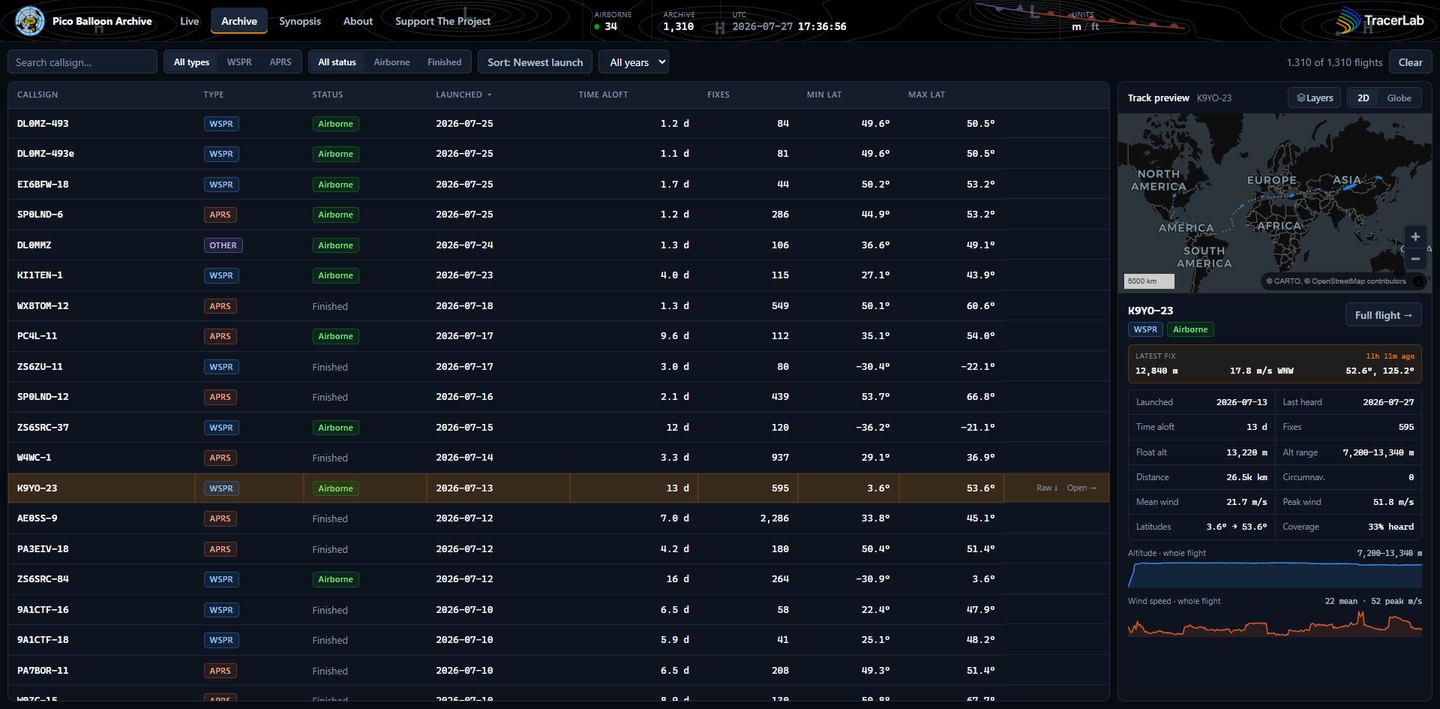
Amateur radio operators have been launching them for years, and receivers all over the world pick up their position reports and pass them on. The Pico Balloon Archive collects that record: every flight, where it went, how long it lasted, and what the air was doing around it.
One balloon launched in May 2022 stayed up for 820 days and covered 1.1 million kilometres — thirty-four laps of the Earth — on a tracker that weighs less than a slice of bread.
Inside
What it looks like in use
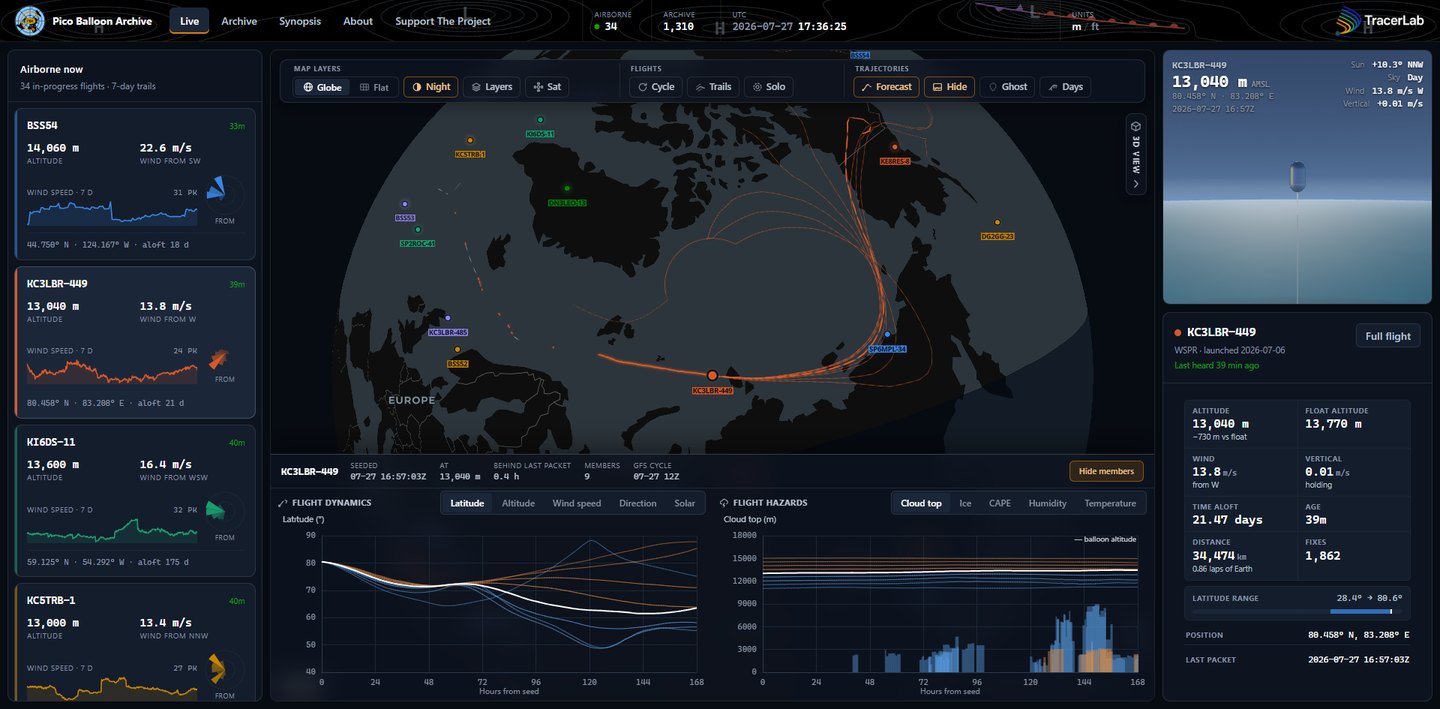
What is in the air right now
Everything airborne at this moment, with its seven-day forecast track ahead of it.
From the data
How many are up there
Balloons sharing the sky, week by week. In early 2021 it was a handful of people; it has not stopped climbing since.
From the data
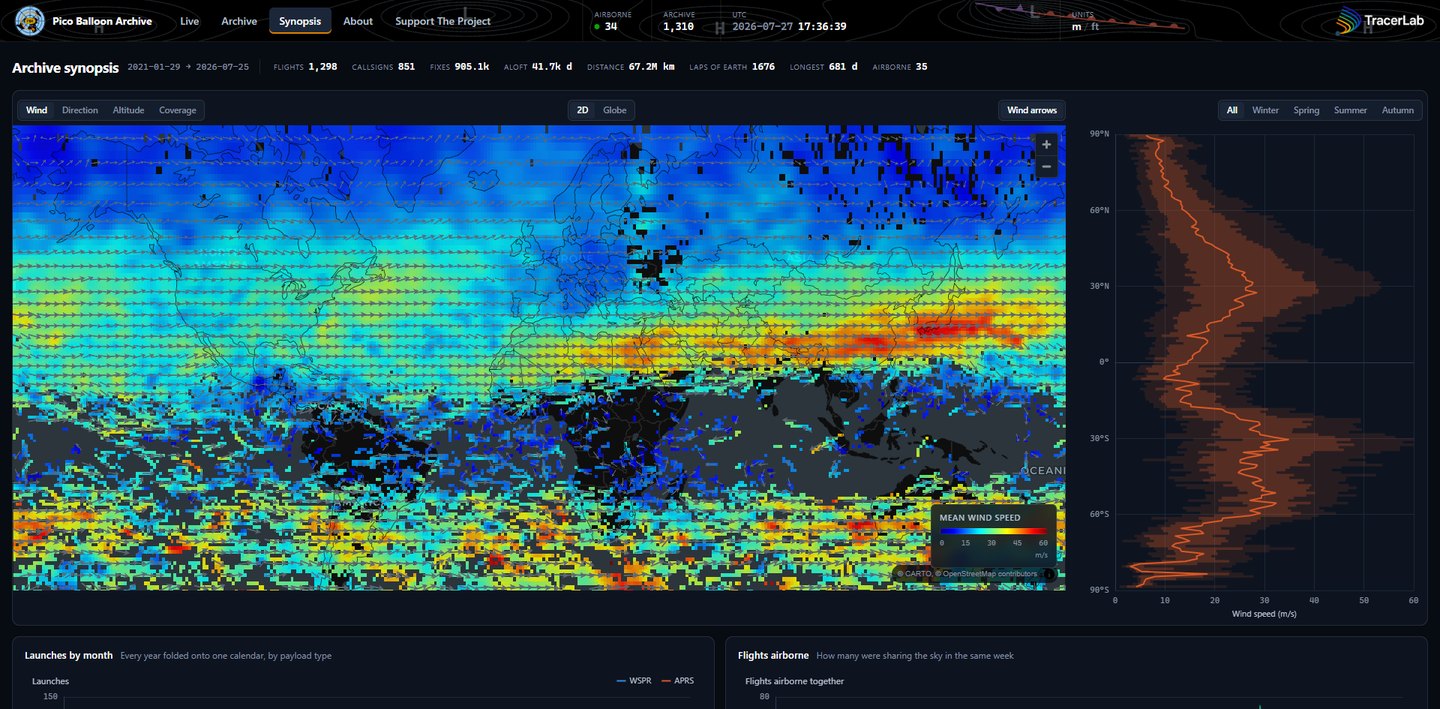
What a million position reports show
Put every flight together and two things fall out: the winds these balloons ride, and the narrow band of air they settle into.
Why it exists
Open, and built on shared data
It is free, and there is no account
Open it and use it. Nothing is paywalled, nothing asks who you are, and every flight can be downloaded as the plain text file it arrived as.
Built on the operators' own data
The position reports come from the amateur radio network that tracks these balloons. The archive reads that record and presents it — it does not re-host or re-publish it as its own.
An unusual look at the low stratosphere
These flights sit for months at an altitude that weather balloons pass through in minutes. Together they are a long, patient record of winds up there that is hard to get any other way.
Free to use
Go and have a look
It opens on whatever is flying at this moment. If you fly these yourself and something looks wrong in your flight's record, tell us — the archive is only as good as what comes in.